
Basic Electricity and Analysis - 2nd chapter (Code: 26711) (English Version). Author: Engr. Dibakar Dey, IIT-Kharagpur
2. CONDUCTOR, SEMI-CONDUCTOR AND INSULATOR
2.1 Define Conductor, Semi-conductor and Insulator
2.2 Explain the Conductor, Semi-conductor and Insulator according to electron theory.
2.3 List different types of Conductors, Semi-conductors and Insulators.
2.4 Describe the factors affecting the resistance of a conductor.
2.5 State laws of resistance.
2.6 Prove the relation, R = ρL/A
2.7 Explain the meaning of resistivity.
2.8 Mention the unit of resistivity.
2.9 Solve problems relating to laws of resistance.
This resource will provide theoretical discussions; explanations and analyses of conductive, semi-conductive and insulating materials in electrical systems; troubleshooting; solutions to mathematical problems; practical guidelines; lecture videos; as well as MCQs (Multiple-Choice Questions), CQs (Creative/Conceptual Questions) and LQs (Long-form/Descriptive Questions).
2nd Chapter: CONDUCTOR, SEMI-CONDUCTOR AND INSULATOR
Introduction: Conductors, semiconductors and insulators have made an immense contribution to the development of modern civilization and the evolution of technology. Classified based on their ability to control electric current, these three types of materials have brought about revolutionary changes across every field from ancient times to the present era of artificial intelligence and space exploration.
Historical Background and Evolution
-
Conductor: In ancient times, metallic substances (such as copper, iron and gold) were used solely for crafting ornaments and weapons. Following the discovery of electricity and magnetism in the 18th and 19th centuries spearheaded by scientists like Alessandro Volta and Michael Faraday conductive materials such as copper and aluminum became the primary media for the generation and transmission of electricity. A conductor is a material that allows electricity or electrons to flow through it with great ease.
-
Insulator: Shortly after the discovery of electricity, the importance of insulating materials for human safety became apparent. Initially, natural rubber, wood, glass and porcelain were used to ensure the safety of electrical wires and equipment. Later, in the 20th century, the invention of plastics and synthetic polymers brought about a radical transformation in electrical insulation systems. An insulator is a material through which electricity or the flow of electrons cannot pass.
-
Semiconductor: In 1833, Michael Faraday observed that the electrical resistance of silver sulfide changes with temperature an observation that marked the beginning of research into semiconductors. However, a true revolution occurred in 1947 with the invention of the transistor. The shift from using bulky vacuum tubes to semiconductors like silicon and germanium ushered in the 'silicon revolution' in the world of electronics. A semiconductor is a material created by combining conductive and non-conductive substances in a specific ratio a process known as "doping" which allows for the flow of a small amount of electricity (or electrons, typically between 5 and 25 volts).
In other words, within an electrical system, a conductive material provides a path for energy, a non-conductive material keeps that energy contained within safe boundaries and a semiconductor precisely regulates the flow of energy as needed thereby imbuing the device with a form of intelligence.
2.1 Define Conductor, Semi-conductor and Insulator
- Conductor: Materials that allow electricity and heat to flow through them very easily and rapidly, with minimal resistance, are called conductors. They contain a large number of free electrons.
Examples: Copper, iron, gold, silver, aluminum and brass etc.
- Insulator: Materials through which electricity or heat cannot flow easily meaning they present significant resistance are called insulators. They contain virtually no free electrons.
Examples: Wood, plastic, glass, rubber, ceramic, ebonite and mica etc.
- Semi-conductor: Materials whose electrical conductivity lies between that of conductors and insulators are called semiconductors. At room temperature, their conductivity is lower than that of conductors but higher than that of insulators. Their conductivity increases as the temperature rises.
Examples: Silicon, germanium, tin, carbon and damp wood etc.
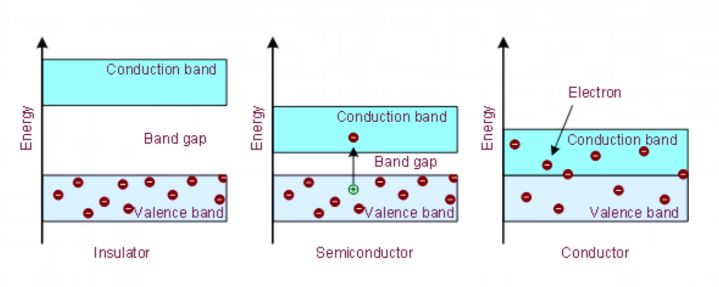
According to Electron Theory and Energy Band Theory, the definitions of free electrons, valence electrons, conductors, semi-conductors and insulators are provided below:
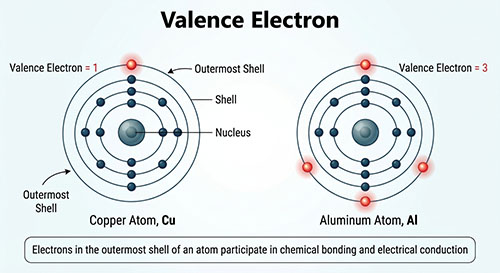
- Valence Electron: Electrons that reside in the outermost energy level or shell of an atom and which participate in the formation of chemical bonds or in electrical conduction are called valence electrons. Whether a substance is a metal or a non-metal can be determined by its valence electrons. These valence electrons also dictate the electrical properties of the substance.
For example: copper has one electron in its outermost shell, so its number of valence electrons is 1; similarly, aluminum has three electrons in its outermost shell, so its number of valence electrons is 3.
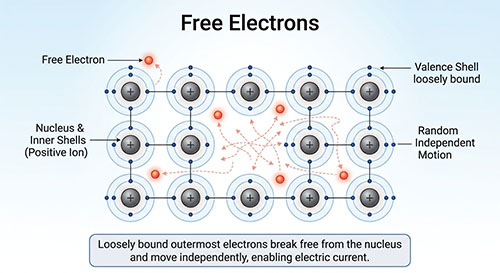
- Free electrons: Electrons in the outermost energy level (valence shell) of an atom that can easily break free from the nucleus's attractive force, move independently (randomly) within a material, and contribute to electric current are called free electrons. They are very loosely bound to the nucleus.
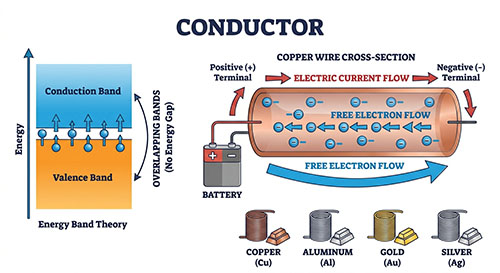
- Conductor: Materials in which the atoms have fewer than four valence electrons, possess a significant number of free electrons in their outermost energy shell, and allow electric current to flow through them easily, are called conductors.
Characteristics: Since the valence band of their atoms typically contains fewer than 4 electrons, the valence band and the conduction band overlap according to energy band theory; consequently, there is no energy gap between them.
Examples: Copper, silver, aluminum, etc.
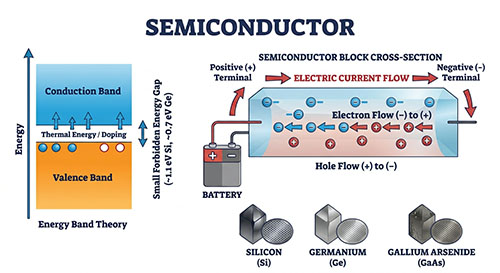
- Semiconductor: Materials in which the atoms have 4 valence electrons and whose electrical conductivity lies between that of a conductor and insulators are called semiconductors.
Characteristics: At room temperature, they contain a small number of free electrons, causing them to behave like poor conductors (insulators). However, their conductivity increases when the temperature is raised, appropriate impurities are added, or they are doped in specific proportions. They typically have 4 electrons in their valence shell. According to energy band theory, there is a very small energy gap (approximately 1.1 eV for silicon) between their valence band and conduction band.
Examples include silicon (Si), germanium (Ge) and carbon (C).
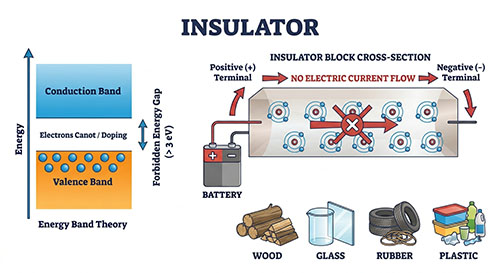
- Insulator: Materials in which the atoms have more than four valence electrons and which, consequently, contain virtually no free electrons and do not allow electric current to flow through them easily are called insulators.
Characteristics: In their atoms, the outermost energy level contains more than 4 electrons (typically 5 to 8), which are very tightly bound to the nucleus. According to energy band theory, there is a large energy gap between their valence band and conduction band; electrons generally lack the energy required to bridge this gap.
Examples: Wood, plastic, glass, rubber, chlorine, neon etc.
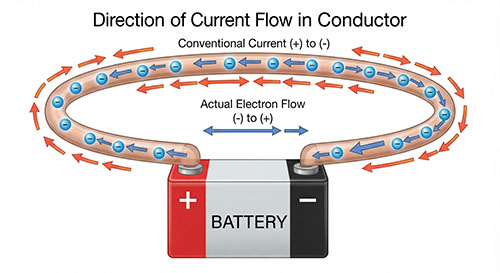
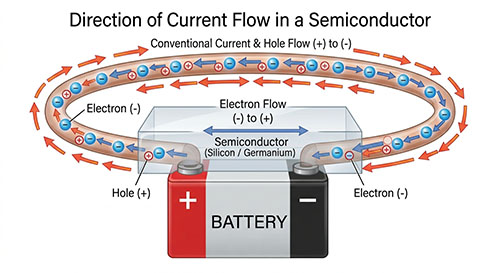
Direction of conventional current flow in conductors and semiconductors: In the context of electric current, the direction of 'conventional current' differs from the actual direction of electron flow. The direction of current flow in conductors and semiconductors is described below:
Direction of Current Flow in a Conductor:
-
Direction of Conventional Current: By convention, current is considered to flow from a higher potential to a lower potential that is, from the positive (+) terminal of a battery or source toward the negative (-) terminal. (This is defined based on the assumed direction of the flow of positive charge.)
-
Direction of actual electron flow: In a conductor (such as a copper, iron, or aluminum wire), the charge carriers are free electrons, which are negatively charged. Therefore, the actual electrons flow from the negative (-) terminal of a battery toward the positive (+) terminal. In other words, the direction of conventional current is the exact opposite of the direction of electron flow.
Direction of Current Flow in a Semiconductor: In a semiconductor material (such as silicon or germanium), current flows primarily through two types of charge carriers: electrons and holes.
-
Electron flow: In the N-type region of a semiconductor much like in a conductor electrons move from the negative (-) terminal toward the positive (+) terminal.
-
Flow of holes: When an electron moves away from a covalent bond, a vacancy or 'hole' is created, which behaves like a positive charge. These holes migrate from the positive (+) terminal toward the negative (-) terminal.
-
Direction of conventional current: In semiconductors too, the direction of conventional current is considered to be the direction of the movement of positive charges or 'holes' that is, from the positive (+) terminal of the battery toward the negative (-) terminal. Conversely, the overall flow of electrons occurs in the exact opposite direction: from the negative terminal toward the positive terminal.
2.2 Explain the Conductor, Semi-conductor and Insulator according to electron theory.
According to electron theory (specifically, energy band theory), materials are classified as conductors, semiconductors or insulators based on the energy levels of the electrons present within them and the availability of free electrons. A brief explanation of these is provided below:
Conductor:
Definition: Materials through which electricity can flow very easily and without obstruction are called conductors.
According to electron theory: in a conductor, the valence band and the conduction band overlap or partially overlap. Consequently, even with the application of a small voltage, a large number of electrons can easily move from the valence band to the conduction band without any hindrance, thereby generating an electric current in the opposite direction. Such materials contain a very high number of free electrons.
Examples: Copper (Cu), aluminum (Al), gold (Au), silver (Ag), etc.
Semiconductor:
Definition: Materials whose electrical conductivity lies between that of conductors and insulators are called semiconductors.
According to electron theory: there exists a very small energy gap known as a "forbidden energy gap" between the valence band and the conduction band (typically about 1.1 eV for silicon and 0.7 eV for germanium). At absolute zero temperature, these materials behave like insulators. However, as the temperature increases or through the introduction of suitable impurities (doping), electrons can gain enough thermal energy to cross the forbidden energy gap and move into the conduction band, thereby enabling electrical conduction.
Examples: Silicon (Si), germanium (Ge), gallium arsenide, etc.
Insulator:
Definition: Materials through which electric current cannot flow easily—or at all—are called insulators.
According to electron theory: the valence band is completely filled with electrons, while the conduction band is entirely empty. The forbidden energy gap (band gap) between these two bands is very large—typically greater than 3 eV. At room temperature, electrons cannot overcome such a high energy barrier to reach the conduction band; consequently, there are virtually no free electrons present.
Examples: wood, glass, rubber, plastic, etc.
Differences between conductors, insulators and semiconductors:
The differences between conductors, insulators and semiconductors are given below:
|
S. No |
Subject / Feature |
Conductor |
insulator | semiconductor |
| 1 |
Power transmission capacity |
It can conduct electricity and heat very easily. |
It does not conduct electricity or heat at all. |
It conducts electricity, falling somewhere between a conductor and an insulator. |
| 2 |
Free electron |
There is a large number of free electrons (10²⁸/m³), but the number of bound electrons is small. |
There are virtually no free electrons, but there is a large number of bound electrons. |
Under normal conditions, the number of free electrons is low; however, it increases when the temperature is raised or through the addition of impurities (doping). |
| 3 |
Band Gap |
There is no energy gap between the valence band and the conduction band (approximately 0 eV). |
The energy gap is very large (greater than 3 eV). |
The energy gap is very small (approximately 1 eV). |
| 4 |
Effect of temperature |
As temperature increases, conductivity decreases (resistance increases). Its coefficient is positive. |
They are not significantly affected by changes in temperature. Their coefficient is negative. |
Conductivity increases as temperature rises. Since resistance decreases with an increase in temperature, its temperature coefficient is negative (-Ve). |
| 5 |
Outermost electron |
Typically, there are 1 to 3 electrons. |
Typically, there are 5 to 8 electrons. |
There are exactly 4 electrons in the outermost shell. |
| 6 |
Example |
Copper, silver, gold, iron, aluminum. |
Wood, glass, plastic, rubber, ceramic. |
Silicon, germanium, gallium arsenide. |
2.3 List different types of Conductors, Semi-conductors and Insulators.
A list & including examples is provided below:
Conductors:
-
Metallic conductors: Silver (the best conductor), copper, gold, aluminum, iron, zinc, nickel, tin, mercury, and brass.
-
Non-metallic conductors: Graphite (an allotrope of carbon).
-
Liquids and aqueous solutions: Saltwater, acidulated water, alkaline solutions, and the human body.
Names of semiconductors:
-
Elemental semiconductors: Silicon (Si), germanium (Ge), selenium (Se) and tellurium (Te).
-
Compound semiconductors: Gallium arsenide (GaAs), indium phosphide (InP), silicon carbide (SiC), cadmium sulfide (CdS) and gallium nitride (GaN).
Names of Insulators (non-conductive materials for electricity):
-
Solid insulators: Dry wood, rubber, plastic, glass, mica, porcelain, paper, cotton, silk, wax, ebonite, and dry soil.
-
Liquid insulators: Pure water (distilled water), transformer oil, or mineral oil.
-
Gaseous insulators: Dry air, nitrogen, hydrogen, and sulfur hexafluoride (SF6).
Below is a list of conductive materials, including their electrical resistivity at a temperature of 20°C:
| S. No |
Names of conductive materials |
Resistivity (ohm-meter) |
| 1 | Silver | 1.59 x 10⁻⁸ Ω-m |
| 2 | Copper | 1.72 x 10⁻⁸ Ω-m |
| 3 | Gold | 2.44 x 10⁻⁸ Ω-m |
| 4 | Aluminium | 2.8 x 10⁻⁸ Ω-m |
| 5 | Tungsten | 5.5 x 10⁻⁸ Ω-m |
| 6 | Mercury | 95.8 x 10⁻⁸ Ω-m |
| 7 | Nichrome | 108 x 10-8 Ω-m |
| 8 | Zinc | 6.2 x 10⁻⁸ Ω-m |
| 9 | Platinum | (9 - 15.5) x 10-8 Ω-m |
| 10 | Lead | 20.8 x 10⁻⁸ Ω-m |
| 11 | German Silver | 20.2 x 10⁻⁸ Ω-m |
| 12 | Manganin | (44 - 48) x 10-8 Ω-m |
Below is a list of non-conductive materials, including their electrical resistivity at a temperature of 20°C:
| S. No |
Names of non-conductive materials |
Resistivity (ohm-meter) |
| 1 |
Bakelite |
102 Ω-m |
| 2 |
Mica |
107 Ω-m |
| 3 |
Rubber |
108 Ω-m |
| 4 |
Glass |
102 - 104 Ω-m |
| 5 |
Amber |
5 x 10⁶ Ω-m |
| 6 |
Sulfur |
107 Ω-m |
2.4 Describe the factors affecting the resistance of a conductor.
The property of a conductor that opposes the flow of current through it is called resistance. The resistance of a conductor primarily depends on four key factors. These factors are described below:
-
Length of the conductor (l)
-
Cross-sectional area of a conductor (A)
-
Material of the conductor (Material / resistivity ρ)
-
Temperature (T)
- Length of the conductor (l):
Relationship: For a given conductor at a specific temperature (T) and with a specific cross-sectional area (A), its resistance is directly proportional to its length. That is, R ∝ L, where A and T are constants.
Description: Increasing the length of a conductor creates greater resistance to the flow of electrons, thereby increasing the resistance. For instance, if the length of a wire is doubled, its resistance also doubles.
- Cross-sectional area of a conductor (A):
Relationship: The resistance of a conductor of a given length (L) at a specific temperature (T) is inversely proportional to its cross-sectional area (A). That is, R ∝ 1/A, where L and T are constant.
Explanation: When the cross-sectional area of a conductor increases, the resistance to the flow of electrons decreases, which results in lower resistance. For example, if the cross-sectional area of a wire is doubled, its resistance is reduced by half (i.e., it becomes 0.5 times the original value).
- Material of the Conductor (Material / Resistivity ρ):
Relationship: At a constant temperature (T), for a conductor with a fixed cross-sectional area (A) and a fixed length (L), the resistance (R) is directly proportional to its resistivity (ρ), R ∝ ρ , where L, A and T remain constant.
Explanation: The resistance of a conductor depends on the material it is made of. Different substances possess varying capacities to impede the flow of electric current. For instance, materials like copper or silver have low resistivity, resulting in lower resistance, whereas nichrome has a higher resistivity.
- Temperature (T):
The resistance of a conductor depends on its temperature. In the case of metallic conductors, resistance generally increases with a rise in temperature because the increased vibration of the atoms creates obstacles to the flow of electrons. Beyond these factors, the resistance of a conductor is also influenced by light, pressure, magnetic fields, and the purity of the material. However, for semiconductors, resistance decreases as the temperature rises.
2.5 State laws of resistance.
The fundamental principles regarding electrical resistance (R) are presented below:
- Laws of Resistance:
Law of Length: At a constant temperature (T) and for a given cross-sectional area (A), the resistance of a conductor is directly proportional to its length (L). That is, R ∝ L, where A and T remain constant.
Formula for cross-sectional area: The resistance of a conductor of a given length (L) at a specific temperature (T) is inversely proportional to its cross-sectional area (A). That is, R ∝ 1/A, where L and T are constants.
Combining these two relationships, we get: R ∝ L/A, or R = ρL/A, where ρ is a constant known as the resistivity (or specific resistance) of the material.
Temperature Dependence: Given constant material and length, the resistance of a metallic conductor generally increases as the temperature rises. In contrast, for a semiconductor, resistance decreases as the temperature rises.
- Ohm's Law:
Provided that the temperature and other physical conditions remain constant, the electric current (I) flowing through a conductor is directly proportional to the potential difference (V) across its two ends. That is, V ∝ I, V = IR, or R = V/I, where R is a constant known as resistance.
- Formulas for Equivalent Resistance:
Series Connection: Rs = R1 + R2 + R3 + ...
Parallel Connection: 1/Rp = 1/R1 + 1/R2 + 1/R3 + ...
- Other Related Formulas:
Conductance (G): G = 1/R
Joule’s Law of Heating: H = I²Rt
2.6 Prove the relation, R = ρL/A
Law of length: At a constant temperature (T) and for a given cross-sectional area (A), the resistance of a conductor is directly proportional to its length (L). Therefore, if the length of a conductor increases, its resistance increases, and if the length decreases, its resistance decreases. In other words, R ∝ L, where A and T are kept constant.
Formula for cross-sectional area: The resistance of a conductor of a given length (L) at a specific temperature (T) is inversely proportional to its cross-sectional area (A). Therefore, if the cross-sectional area of a conductor increases, its resistance decreases, and if the cross-sectional area decreases, its resistance increases. In other words, R ∝ 1/A, where L and T are constant.
Combining these two relations, we get: R ∝ L/A or R = ρL/A, where ρ is a constant known as resistivity (or specific resistance) of the material. It depends on the material of the conductor.
Temperature dependence: For a given material and length, the resistance of a metallic conductor generally increases as the temperature rises. In contrast, for a semiconductor, the resistance decreases as the temperature rises.
2.7 Explain the meaning of resistivity.
Resistivity (or specific resistance) is an intrinsic or fundamental property of a material, which indicates the extent to which the material opposes the flow of electric current passing through it.
Mathematical formula: For a conductor with resistance (R), length (L), and cross-sectional area (A), the formula for resistivity is: ρ = RA/L.
Here, if L = 1 (unit length) and A = 1 (unit cross-sectional area), then ρ = R.
In simple terms, the resistance of a conductor with a unit length and a unit cross-sectional area at a specific temperature is defined as the resistivity of that material.
Characteristics: It depends entirely on the nature of the material and its temperature. Resistivity does not depend on the length or thickness of the conductor. For instance, while a small piece of copper or aluminum and a long, thick wire made of the same material will have different resistances, their resistivity remains the same.
S.I. or M.K.S. system, its unit is ohm-meter (Ω-m);
C.G.S. system, its unit is ohm-centimeter (Ω-cm); and
F.P.S. system, its unit is ohm-inch (Ω-inch).
2.8 Mention the unit of resistivity.
The S.I. unit of resistivity is the ohm-meter (Ω-m).
Description and definition of the unit: Resistivity is an intrinsic property of a conducting material, which depends on temperature. The definition of its unit is derived from the following formula: ρ = RA/L
Where,
ρ (rho) = resistivity
R = resistance of the conductor (unit: ohm, Ω)
A = cross-sectional area of the conductor (unit: square meter, m²)
L = length of the conductor (unit: meter, m)
Derivation of the unit: Unit of resistivity = {ohm (Ω) × m²}/m = ohm (Ω) × m = ohm-meter (Ω-m)
What is meant by ohm-meter (Ω-m)?
The resistivity of a material is defined as the resistance (in ohms) of a conductor made of that material, having a length of 1 meter (1m) and a cross-sectional area of 1 square meter (1m²), at a specific temperature.For example: the resistivity of copper being 1.72 x 10⁻⁸ Ω-m means that a copper wire with a length of 1m and a cross-sectional area of 1m² has a resistance of 1.72 x 10⁻⁸ Ω.
Meaning and Units of Conductance and Specific Conductance:
Conductance (G) refers to the ease with which electric current flows through a conductor; it is the reciprocal of resistance. In other words, it represents the capacity of a conductor to allow the flow of electric current.
If the resistance of a conductor is R, then conductance (G) = 1/R = A/ρL.
The unit of conductance (G) = (1/ohm·m) × m²/m = 1/ohm·m = mho (℧).
Specific conductance (or conductivity) is defined as the conductance of a conductor having a unit length and a unit cross-sectional area; alternatively, it is the reciprocal of specific resistance (ρ). In simpler terms, the conductance of a conductor with a length of 1 meter and a cross-sectional area of 1 square meter is called specific conductance.
Specific conductance (or conductivity) (k) = 1/ρ = 1/ohm-m = mho m⁻¹
2.9 Solve problems relating to laws of resistance.
1.
Answer:
2.
Answer:
Very Short Question:
Q. No 1. On what factors does the resistance of a conductor depend?
Answer: The resistance of a conductor depends on the following factors:
-
Length of the conductor (l)
-
Cross-sectional area of the conductor (A)
-
Material of the conductor (material / resistivity ρ)
-
Temperature (T)
Q. No 2. What is meant by a non-conductor or insulator?
Answer: Materials through which electricity or heat cannot flow easily meaning they offer significant resistance are called non-conductors or insulators. They contain virtually no free electrons.
Examples: Dry Wood, plastic, glass, rubber, ceramic, ebonite, mica, etc.
Q. No 3. What is a semiconductor?
Answer: Materials whose electrical conductivity lies between that of conductors and insulators are called semiconductors. At room temperature, their conductivity is lower than that of conductors but higher than that of insulators. Their conductivity increases as the temperature rises.
Examples: Silicon, germanium, antimony, tin, carbon, arsenic, damp wood, etc.
Q. No 4. Define resistivity (specific resistance), including its unit.
Answer: At a given temperature, the resistance of a conductor having unit length and unit cross-sectional area is called the resistivity of that material. In the S.I. or M.K.S. system, its unit is ohm-meter (Ω-m).
Q. No 5. What is a conductor?
Answer: Materials through which electricity and heat can flow very easily and rapidly, encountering minimal resistance, are called conductors. They contain a large number of free electrons.
Examples: Copper, iron, gold, silver, aluminum, brass, etc.
Q. No 6. What is meant by the temperature coefficient of resistance?
Answer: The change in resistance of a conductor (in ohms) resulting from a 1°C rise in its temperature starting from an initial temperature of 0°C is defined as the temperature coefficient of resistance (α).
Temperature coefficient of resistance (α) = (Rt - R0) / (R0t)
Q. No 7.