
Chapter-1: ELECTRICITY AND ITS NATURE
1.1 State the meaning of electricity.
1.2 Describe the structure of atom.
1.3 Define current, voltage and resistance.
1.4 Mention units of current, voltage and resistance.
Will be provided its theory, Explanation of the electrical system and analysis, Troubleshorting, solve Math problems, practical guide, Lecture Video and MCQ, CQ, LQ.
ELECTRICITY AND ITS NATURE
Introduction:
The history of electricity spans thousands and thousands of years; beginning with ancient observations of natural phenomena, it has evolved into a fundamental pillar of modern science and industry. Today, electricity has become a basic right much like food, clothing and shelter.
In 2750 BCE, various ancient Egyptian records mention an awareness of electric shocks caused by certain fish (such as electric catfish and rays); at that time, these fish were referred to as the "protectors" of other fish.
In 600 BCE, the ancient Greek philosopher Thales of Miletus discovered static electricity while rubbing amber with wool or silk; he observed that it attracted light objects such as feathers or dust particles. The term 'electricity' is derived from 'electron,' the Greek word for amber.
1600 – English scientist William Gilbert published the book *De Magnete*. In it, he introduced the term "electricus" (derived from the Greek word "elektron," meaning "amber") to describe the force of attraction; the word "electricity" is directly derived from this term.
In 1660, the German scientist Otto von Guericke built an early electrostatic generator and Robert Boyle demonstrated that electric force or energy could travel through a vacuum.
In the 1880s, the "War of the Currents" emerged as an intense rivalry between Thomas Edison (who favored direct current or DC) and Nikola Tesla and George Westinghouse (who advocated for alternating current or AC). Ultimately, AC emerged victorious for long-distance power distribution.
1.1 State the meaning of electricity.
In 600 BCE, the ancient Greek philosopher Thales of Miletus discovered static electricity while rubbing amber with wool or silk; he observed that an invisible force attracted light objects, such as feathers or dust particles. Electricity is a form of invisible energy that arises from the stationary state or movement of electrons—particles carrying an electric charge. While electricity cannot be seen with the naked eye, its effects or presence can be perceived. Electricity plays an indispensable role in almost every aspect of modern civilization.
Therefore, we can say that any movement of electrons or electrically charged particles is called electricity.
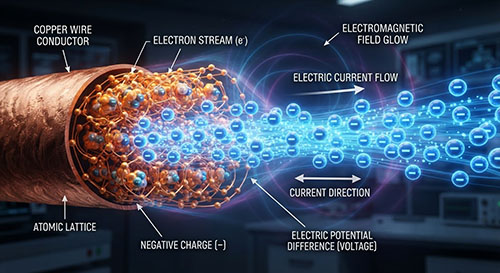
British scientist Michael Faraday discovered the fundamental principles of electricity between the 1820s and the 1830s. Electricity is generated by the flow of particles called electrons within an atom or by variations in electrical charge. It can be easily converted into light, heat, sound and mechanical energy.
Definition of electricity: Electricity is a form of invisible energy that can be rapidly converted into light, heat, sound and mechanical energy and which enables the accomplishment of many practical tasks in the modern world.
Types of Electricity:
Electricity is primarily of two types, namely:
1. Static electricity and
2. Current electricity.
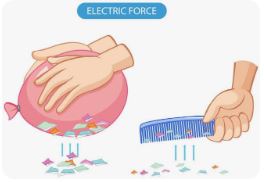
- Static electricity: When an electric charge is accumulated or confined on the surface or at the source of an object and remains in a stationary state, it is called static electricity.
In most cases, it is generated through friction. For example, if you comb your dry hair with a plastic comb and then hold the comb near small pieces of paper, it will attract them. Another example is the charge stored on the plates of a capacitor, which is also static electricity. In each of these instances, electrons are transferred from one object to another, resulting in the generation of static electricity on those objects.
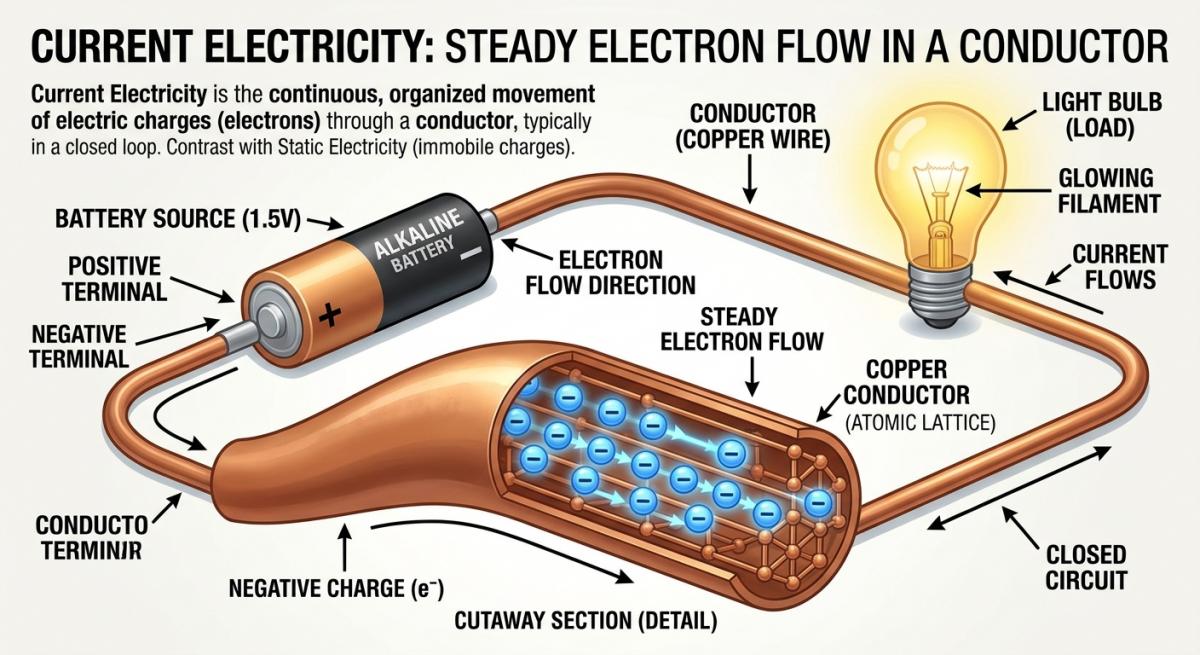
- Current electricity: When electrons flow continuously or steadily through a conductor (such as a wire), it is called current electricity.
The use of current electricity is essential in every aspect of life. The electricity used in homes, offices, and industrial facilities is this very type of current electricity.
Electric current is further divided into two types:
-
Direct Current (DC): Current that always flows in the same direction, or whose magnitude and direction remain constant over time, is called Direct Current (DC). (For example, the current from a battery.)
-
Alternating Current (AC): Current whose magnitude and direction change periodically over time is called Alternating Current (AC). (For example, the electricity supplied to our homes via the main power lines.)
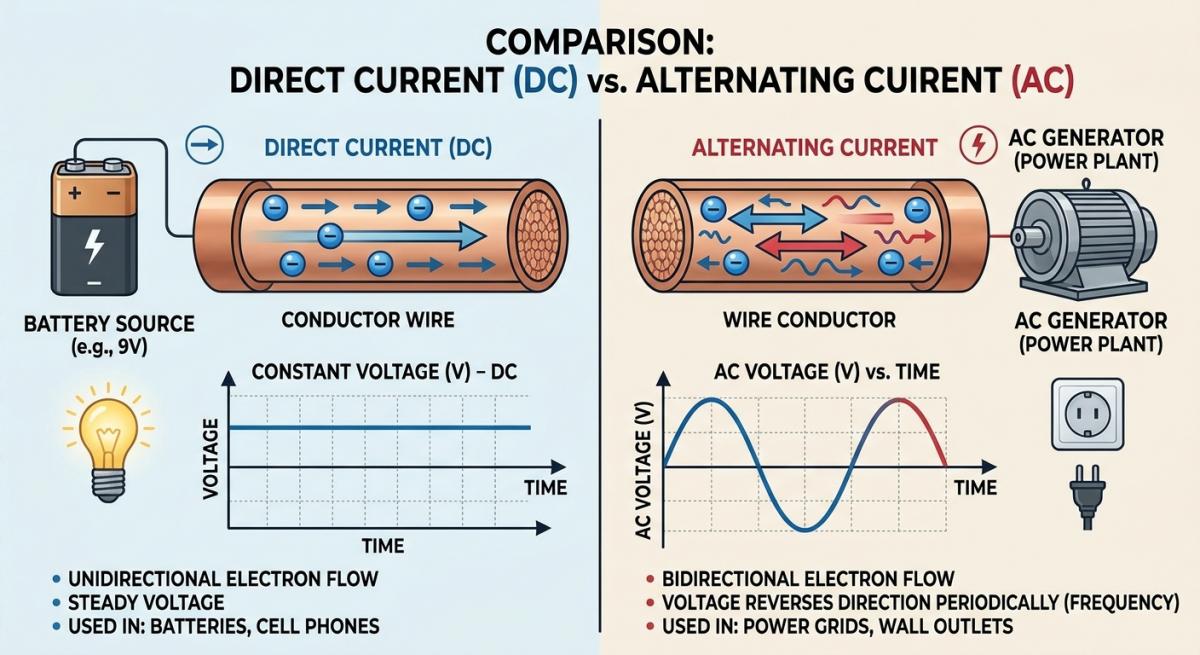
Difference between DC and AC current:
|
Features: |
AC current (AC / Alternating Current) |
DC Current (Direct Current) |
|
Direction of flow: |
It is a bidirectional or periodic flow; its direction changes at regular intervals. |
It is a unidirectional flow; the current always flows in the same direction. |
|
Frequency: |
It has a specific frequency. (For example, typically 50 Hz or 60 Hz, meaning it changes direction 50 or 60 times per second). |
It has no frequency. (Frequency = 0). |
|
Source: |
AC generator or alternator. |
Battery, solar panel (solar cell) and DC generator. |
|
Voltage and Polarity: |
Its polarity changes over time. |
Its polarity remains constant (one positive and one negative terminal). |
|
Long-distance transmission: |
More cost-effective and efficient for supplying electricity over long distances. |
Significant energy loss occurs during long-distance transmission (though High-Voltage Direct Current HVDC is an exception). |
|
Usage: |
Homes, large industrial factories and heavy electrical machinery. |
Mobile phones, laptops, electronic devices, LED lights, and electric vehicles (EVs). |
|
Risk: |
An electric shock can cause muscles to contract and expand, which can sometimes be fatal. |
An electric shock can also cause muscles to remain in a state of continuous contraction. |
Use of DC & AC current: The use of AC (alternating current) and DC (direct current) electricity differs depending on the nature of their operation.
AC (Alternating Current) is used in various applications: Since AC periodically changes its direction (for instance, 50 or 60 times per second), its voltage can be easily increased or decreased using a transformer, making it ideal for transmitting electricity over long distances. It serves as the primary power supply for homes, offices and industrial facilities and is used to operate appliances and equipment such as refrigerators, air conditioners (AC), washing machines, ceiling fans, heavy machinery, light bulbs and large motors.
DC (Direct Current) electricity is used in various applications: Since DC electricity flows consistently in one direction and maintains a constant voltage or polarity, it can be stored in batteries and is highly safe for use in sensitive electronic devices. It is utilized in mobile phones, laptops, various types of batteries and power banks, solar panels (which generate DC electricity), LED lights and their drivers, electric vehicle (EV) battery systems, low-voltage control circuits and computer components.
List of thermal, magnetic and chemical effects of electric current:
Effect of electric current Or Consequences of electric current flow: When an electric current flows through a conductor or medium, it produces three primary physical and physiological effects.
1. Heating Effect (Joule Heating)
2. Magnetic Effect
3. Chemical Effect
4. Biological and Physiological Consequences (Electric Shock)
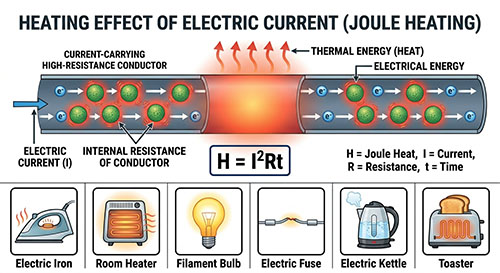
- Heating Effect (Joule Heating): This is a process in which electrical energy is converted into thermal energy due to the internal resistance of a conductor when an electric current flows through it. In simpler terms, the heating of a wire as electric current passes through it caused by the resistance or opposition offered by the conductor is known as the thermal effect of electricity.
For example, electric irons, heaters, electric bulbs (filament bulbs), electric fuses, electric kettles, toasters, welding machines, etc are examples of the heating effect.
Why do thermal effects occur?
Any conductor (such as a copper, aluminum or nichrome wire) contains a large number of free electrons. When a potential difference (voltage) is applied across the two ends of the conductor, the pressure from this voltage causes the electrons within the conductor to begin moving in a specific direction a phenomenon we refer to as electric current.
As they move, electrons continuously collide with the atoms or ions inside the conductor. These collisions or the resistance they create constitute what is known as 'resistance'. Through these collisions, the kinetic energy of the electrons is transferred to the atoms of the conductor, causing the atoms to vibrate more intensely, which in turn makes the conductor heat up.
Note: Joule's laws of heating, the transformation of energy and the effect of thermal processes on power will be discussed later.
-
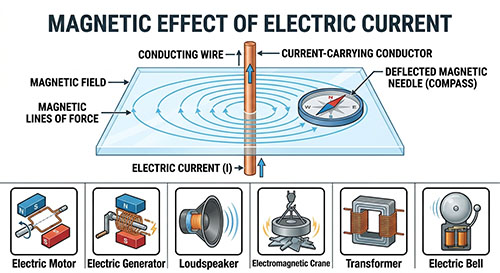
Magnetic Effect: When an electric current is passed through a conducting wire placed over a compass or a magnetic needle, a magnetic field is generated in the region surrounding the conductor due to the presence of magnetic lines of force. This field is represented by imaginary lines known as 'magnetic lines of force.' In other words, the magnetic field created around a conductor as a result of the lines of force which are produced by the flow of electric current through that conductor is referred to as a 'magnetic effect.'
For example, electric motors, electric generators, loudspeakers, microphones, electromagnetic cranes, MRI machines, transformers, electric bells, etc are examples of the magnetic effects of electricity.
Why do Magnetic Effects occur?
When a current-carrying conductor is placed within a magnetic field (or in the presence of a magnetic material), it experiences a mechanical force and tends to undergo displacement. The magnitude of this force depends on three factors:
1. The amount of electric current (the force increases as the current increases)
2. The intensity of the magnetic field
3. The length of the conducting wire
Furthermore, an insulated copper wire wound into a tight, cylindrical coil is called a solenoid. When an electric current flows through this solenoid, it behaves like an ordinary bar magnet; one end acts as the North Pole, while the other acts as the South Pole. If a soft iron rod is inserted into the solenoid, its magnetic strength increases significantly a device known as an electromagnet.
It generally operates according to Fleming's Right-Hand Thumb Rule and Maxwell's Corkscrew Rule. This is how magnetic action occurs.
-
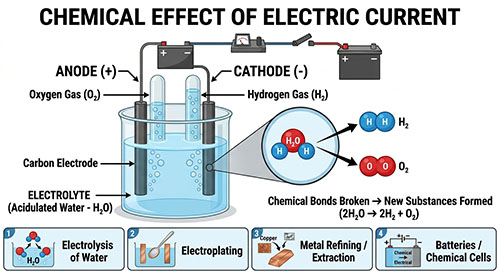
Chemical Effect: Chemical effects or chemical reactions are processes involving components such as electrolytes and electrodes that encompass various types of reactions (such as combination, decomposition, substitution and combustion), through which one or more substances are transformed into entirely new substances with different properties. In this process, the existing chemical bonds between the molecules or atoms of the substances are broken and new bonds are formed, resulting in the creation of new molecules.
For example, when an electric current is passed through water (H2O) mixed with an acid, it breaks down into hydrogen (H2) and oxygen (O2) substances with entirely different properties. This is the result of electroplating or a chemical process.
Why do Chemical Effects occur?
Chemical processes or chemical reactions primarily occur through the breaking of existing chemical bonds and the formation of new ones between the atoms or molecules of substances. The fundamental objectives of these processes include enabling atoms to achieve greater stability (often described by the Octet Rule), facilitating electron interactions, inducing energy changes or as explained by Collision Theory reaching a new, more stable state through appropriate molecular collisions.
-
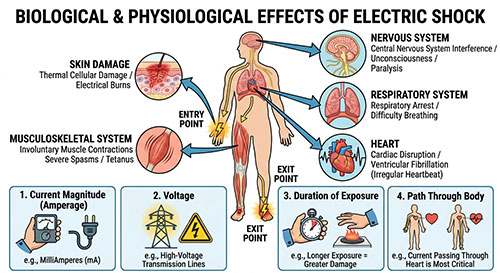
Biological and Physiological Consequences (Electric Shock): When an electric current passes through the human body, it disrupts the normal functioning of cells, tissues, and various organs including the heart, nervous system, musculoskeletal system, and respiratory system while also causing thermal effects, cellular damage, and other long-term consequences. These biological and physiological outcomes of an electric shock depend primarily on the magnitude of the current (amperage), the voltage, the duration of exposure, and the specific path the electricity takes through the body.
Why do Biological and Physiological Consequences (Electric Shock) occur?
The human body itself is a good conductor of electricity and our nervous system and muscles operate through their own minute electrical signals. When a strong external electric current passes through the body, it completely disrupts the normal functioning of these internal minute electrical signals.
1.2 Describe the structure of atom.
An atom is the smallest particle of an element; it lacks an independent existence but can participate directly in chemical reactions as well as in various electrical and electronic processes. An atom essentially consists of two main parts: the nucleus (the central core, containing protons and neutrons) and the electron shells surrounding it.
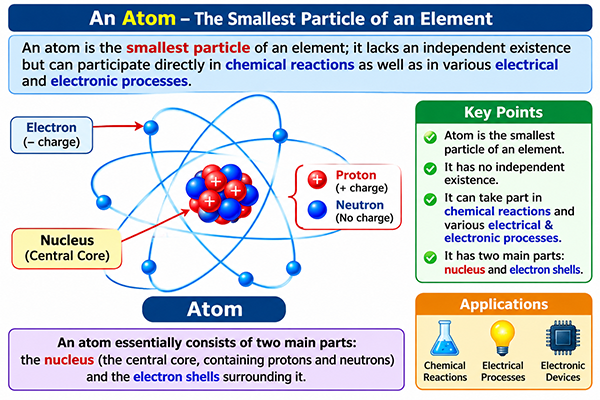
The structure of an atom is discussed in detail below:
An atom is primarily composed of three stable fundamental particles:
-
Proton (p): Discovered by Ernest Rutherford in 1911. It is a positively charged (+1) particle and is located in the nucleus of an atom.
-
Neutron (n): Discovered by James Chadwick in 1932. It is an uncharged or neutral particle and resides in the nucleus alongside protons.
-
Electron (e): Discovered by J. J. Thomson in 1897. It is a tiny, negatively charged (-1) particle that orbits the nucleus within specific energy levels or shells.
Furthermore, particles such as mesons, neutrinos and antineutrinos are unstable subatomic particles. Based on the structural arrangement of an atom, there are two main components:
- Nucleus: Protons and neutrons are located together at the very center of an atom; this is called the nucleus. Almost the entire mass of an atom is concentrated within the nucleus. The nucleus is extremely small in size compared to the atom as a whole. Within it, protons carry a positive (+Ve) charge, while neutrons are electrically neutral; both remain stationary.
- Energy Level or Shell: The circular paths along which electrons move outside the nucleus are called energy levels or orbits. Electrons carry a negative (-Ve) charge and are unstable. These are typically represented by letters such as K, L, M, N, etc. The formula for determining the electron capacity of each level is 2n2 (where 'n' is the number of the energy level).
-
(K) shell (n=1): maximum 2 electrons (= 2 x 1² = 2 x 1 = 2)
-
(L) shell (n=2): maximum 8 electrons (= 2 x 2² = 2 x 4 = 8)
-
(M) shell (n=3): maximum 18 electrons (= 2 x 3² = 2 x 9 = 18)
-
(N) shell (n=4): maximum 32 electrons (= 2 x 4² = 2 x 16 = 32)
The characteristics of electrons, protons and neutrons are given in the table below:
|
Characteristics of atomic particles |
Electrons |
protons |
neutrons |
| Atomic Nature |
An electron is a -Ve charged permanent atomic particle that Which revolves around the nucleus in a specific orbit.
|
A proton is a +Ve charged, stable atomic particle that resides in the nucleus alongside neutrons. |
A neutron is a stable, electrically neutral subatomic particle that resides in the nucleus alongside protons. |
|
Mass |
9.1 x 10⁻³¹ kg | 1.67 x 10⁻²⁷ kg |
Depending on the atom, its mass is equal to or greater than that of a proton. |
| Charge | -1.602 x 10⁻¹⁹ Culamb | +1.602 x 10⁻¹⁹ Culamb |
Its charge is zero. |
| Redious | 2.82 x 10⁻¹⁵ m | 8.4 x 10⁻¹⁶ m | 8 x 10-16 m |
Why are atoms neutral?
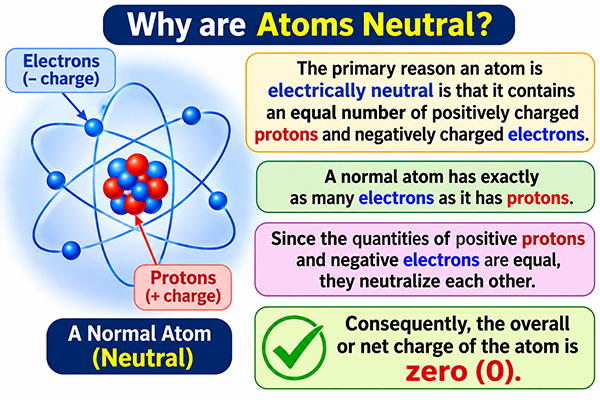
The primary reason an atom is electrically neutral is that it contains an equal number of positively charged protons and negatively charged electrons. In other words, a normal atom has exactly as many electrons as it has protons. Since the quantities of positive protons and negative electrons are equal, they neutralize each other. Consequently, the overall or net charge of the atom is zero (0).
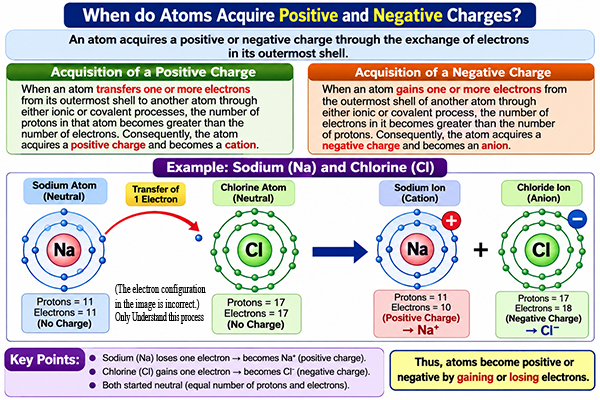
When do atoms acquire positive and negative charges?
An atom acquires a positive or negative charge through the exchange of electrons in its outermost shell:
Acquisition of a positive charge: When an atom transfers one or more electrons from its outermost shell to another atom through either ionic or covalent processes the number of protons in that atom becomes greater than the number of electrons. Consequently, the atom acquires a positive charge and becomes a cataion.
Acquisition of a negative charge: When an atom gains one or more electrons from the outermost shell of another atom through either an ionic or a covalent process the number of electrons in it becomes greater than the number of protons. Consequently, the atom acquires a negative charge becoming an anion.
For example, both a sodium atom and a chlorine atom have an equal number of electrons and protons; therefore, both are electrically neutral. However, when a sodium atom transfers an electron from its outermost shell to the outermost shell of another atom through an ionic or covalent process the number of protons in the sodium atom becomes greater than the number of its electrons. As a result, the sodium (Na) acquires a positive (+) charge (Na+).
Similarly, when a chlorine atom acquires an electron from another atom through either an ionic or a covalent process into its outermost shell, the number of electrons in the chlorine atom exceeds the number of protons; consequently, the chlorine (Cl) acquires a negative (-) charge (Cl⁻).
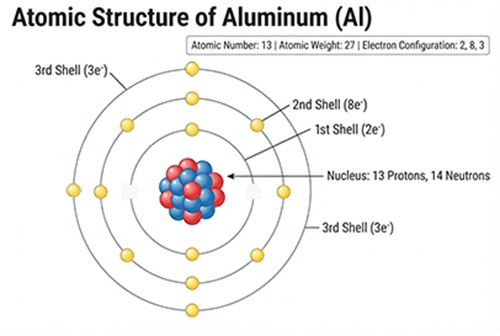
Atomic structure of aluminum:
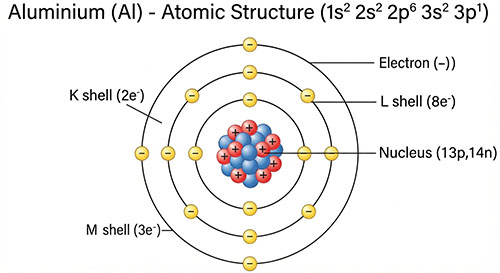
Atomic number of aluminum = 13
Atomic weight = 27
Therefore, number of protons = 13
Number of electrons = 13
And number of neutrons = 27 - 13 = 14
Electron configuration in the 1st shell of aluminum = 2n² = 2 x 1² = 2
Electron configuration in the 2nd shell of aluminum = 2n² = 2 x 2² = 8
Electron configuration in the 3rd shell of aluminum = 13 - (8 + 2) = 3
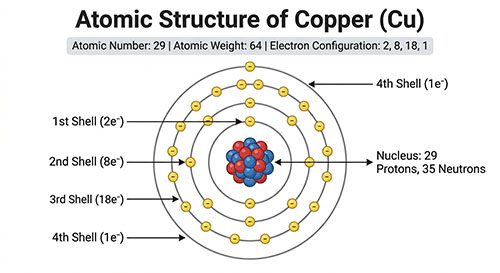
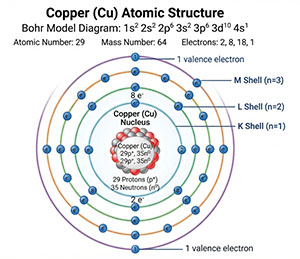
Atomic structure of copper:
Atomic number of copper = 29
Atomic weight = 64
Therefore, number of protons = 29
Number of electrons = 29
And number of neutrons = 64 - 29 = 35
Electron configuration in the 1st shell of copper = 2n² = 2 x 1² = 2
Electron configuration in the 2nd shell of copper = 2n² = 2 x 2² = 8
Electron configuration in the 3rd shell of copper = 2n² = 2 x 3² = 18
Electron configuration in the 4th shell of copper = 29 - (18 + 8 + 2) = 1
Note: To gain a thorough understanding of the atomic structure and electron configuration of various elements, one must study the periodic table in a chemistry textbook with great care.
1.3 Define current, voltage and resistance.
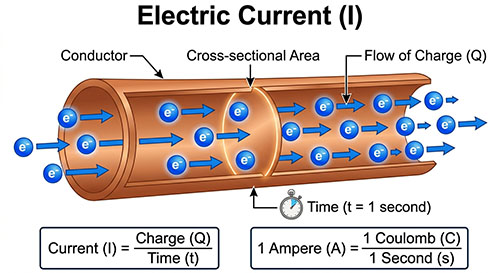
Definition of Electric Current: We know that if a quantity of charge, Q flows through a conductor in 1 second, it is called electric current. In other words, the amount of charge (or number of electrons) flowing through a conductor per second is defined as electric current. It is denoted by the symbol I.
Explanation: If a charge of Q coulombs flows through a conductor in time t, then the current (I) = Q/t coulombs per second. A coulomb per second is referred to as an 'ampere'.
Therefore, if Q = 1 coulomb and t = 1 second, then I = 1/1 = 1 ampere. In other words, if 1 coulomb of charge (or electrons) flows through a conductor in 1 second, the current is 1 ampere. It is denoted by the symbol A.
Definition of an International Ampere: An international ampere is defined as the amount of electric current that, when passed through a solution of silver nitrate (AgNO₃) for 1 second, causes 0.001118 grams of silver to be deposited (precipitated) from the solution. The instrument used to measure this current is called an ammeter.
Definition of a coulomb:
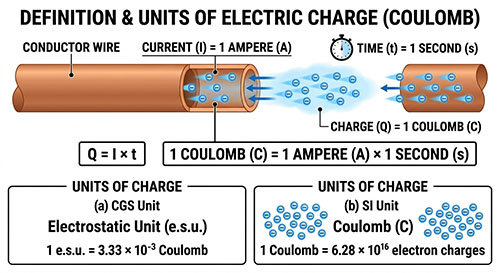
Definition of a Coulomb: When a current of 1 ampere flows through a conductor in 1 second, the charge is said to be 1 coulomb. It is typically denoted by the symbol C.
Explanation: From the definition of electric current, we know that current (I) = Q (coulomb) / t (time); therefore, Q (coulomb) = current (I) × t (time). Here, if the current (I) is 1 ampere and the time (t) is 1 second, then Q (coulomb) will be 1 coulomb.
Units of charge:
(a) The CGS unit of charge is the Electrostatic Unit (e.s.u.). 1 e.s.u. = 3.33 × 10⁻³ Coulomb.
(b) The International System (SI) unit of charge is the Coulomb. 1 Coulomb = 6.28 × 10¹⁶ electron charges.
Definitions of potential and potential difference (voltage):
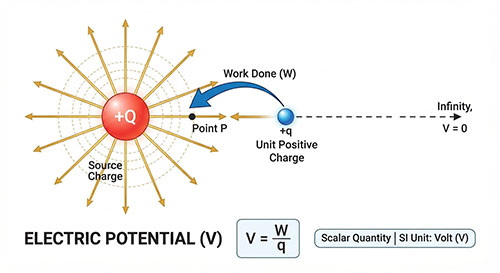
Electric potential: Electric potential is defined as the amount of work done in bringing a unit positive charge from an infinite distance to a specific point within an electric field. In other words, the capacity of a charged object to perform work is called electric potential.
Explanation of Electric potential: The electric potential at a specific point in an electric field is defined as the amount of work done in bringing a unit positive charge from infinity (or a point of zero potential) to that point.
Mathematical formula of Electric potential: If an amount of work "W" is required to bring a positive charge "q" from infinity to a point in an electric field, then the electric potential "V" at that point is given by V = W/q.
Units: In the SI system, the unit of work is the joule and the unit of charge is the coulomb; therefore, the unit of the volt is the joule per coulomb. This "joule per coulomb" is called a volt. In other words, it is a scalar quantity and its SI unit is the volt (V).
Definition of a Volt: According to the mathematical formula, voltage (V) = work (W) / charge (q). Here, if work (W) = 1 joule and charge (q) = 1 coulomb, then voltage (V) = 1 joule / 1 coulomb = 1 volt.
In other words, if one joule of work is required to bring a positive charge of 1 coulomb from an infinite distance to a specific point within an electric field, then the potential at that point is defined as 1 volt.
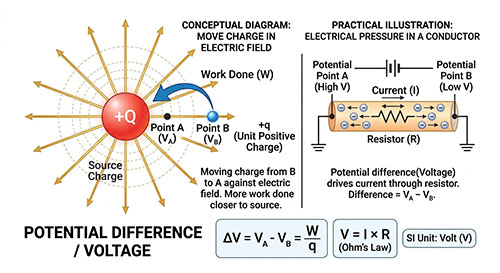
On the other hand, potential difference or voltage: potential difference or voltage is the amount of work done in moving a unit positive charge from one point to another within an electric field. Simply put, the difference in potential between any two points in an electric field is known as potential difference or voltage.
Explanation of potential difference or voltage: The work done in moving a unit positive charge from one point to another within an electric field is called the potential difference or voltage between those two points. In simpler terms, voltage is the difference in electrical pressure between the two ends of a conductor which drives the flow of electricity or electrons in a specific direction within a circuit. Electrons always flow from a region of higher potential to a region of lower potential. Its SI unit is the volt.
According to mathematical principles of potential difference or voltage: if an amount of work W is done to move a charge q from point A to point B in an electric field, the potential difference between the two points is given by VA - VB = W/q. According to Ohm's law, V = I x R (where I is the electric current and R is the resistance). Therefore, VA - VB ~ I, or VA - VB = IR (where R is a constant known as resistance).
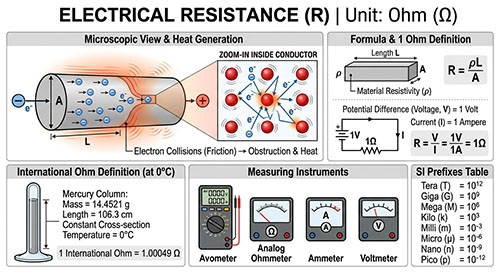
Definition of Resistance: When electrons flow through a conductor or an electrical medium under the pressure of a voltage or potential difference, they encounter friction from the electrons of the other molecules or atoms present within that medium. This results in the obstruction of the electron flow; furthermore, if the cross-sectional area (or radius) of the conductor is small, this process generates heat.
Therefore, "the property of a conductor or material that hinders the flow of current driven by voltage and generates heat as a result of this current flow is called the resistance of the conductor." Resistance is denoted by "R" and its unit is the ohm.
In other words, if a conductor has a unit length and a unit cross sectional area and the specific resistance (resistivity) of its material is also unity then the resistance of that conductor is said to be 1 ohm. (We know that R = ρL/A)
Alternatively, "If a potential difference of one volt is applied across the two ends of a conductor and a current of one ampere flows through it then the resistance of that conductor is 1 ohm."
International definition of the ohm: At a temperature of 0°C, the resistance offered to a steady electric current by a column of mercury having a mass of 14.4521 grams, a length of 106.3 centimeters and a uniform cross section is defined as 1 international ohm.
1 international ohm = 1.00049 ohms. It is represented by the symbol Ω. Resistance is measured using an ohmmeter. Current is measured using an ammeter. Voltage is measured using a voltmeter, while an avometer & Multimeter can be used to measure both current and voltage.
we know, 1 Tera = 1012 , 1 Giga = 109 , 1 Mega = 106, 1 Killo = 103, 1 Milli = 10-3, 1 Micro = 10-6, 1 Nano = 10-9 , 1 Pico = 10-12
1.4 Description of the units for electric current, potential difference and resistance:
- Electric Current: The amount of charge that flows in a specific direction through an electrical circuit or conductor per unit of time driven by the pressure of a potential difference (voltage) is called current. Current (I) = Q/t (where Q is the charge and t is the time).
Unit: In the S.I. system, the unit of current is the Ampere.
There are three types of units for current, namely:
1. E.S.U. (electrostatic unit) in the C.G.S. system:
1 E.S.U. of current = 1/(3 x 10⁹) Ampere = 3.3356 x 10⁻¹⁰ Ampere
Or, 1 Ampere = 3 x 10⁹ E.S.U.
2. E.M.U. (electromagnetic unit) in the C.G.S. system:
1 E.M.U. of current = 10 amperes.
3. The S.I. unit, the ampere is named after the French scientist André-Marie Ampère.
- Voltage: Voltage is the pressure that drives the flow of electricity. It is defined as the potential difference between the two ends of a conductor that enables current to flow through it. The greater the potential difference or voltage pressure the better the flow of electric current. Typically, the voltage is 230 volts for a single-phase system and 415 volts for a three-phase system.
Voltage V = IR (where I = current, and R = resistance of the conductor)
Unit: In the S.I. system, the unit of voltage is the Volt.
There are three types of units for voltage:
1. E.S.U. (electrostatic unit) in the C.G.S. system:
1 E.S.U. of voltage ≈ 300 Volts.
Or, 1 Volt = 3.336 × 10⁻³ E.S.U.
2. E.M.U. (electromagnetic unit) in the C.G.S. system:
1 E.M.U. of voltage = 10⁻⁸ Volts.
Or, 1 Volt = 10⁸ E.M.U.
3. The S.I. unit, the Volt, is named after the renowned Italian physicist and chemist Alessandro Volta.
- Resistance: The opposition encountered by an electric current as it flows through a conductor is called resistance. It is denoted by the symbol R.
According to Ohm's Law, resistance (R) = V/I (where V = voltage and I = current). If I = 1, then R = V; in other words, the potential difference (or voltage) required to drive a unit amount of current through a conductor is defined as resistance.
Unit of Resistance: The ohm (symbol: Ω). It is measured using an ohmmeter.
Mho: The reciprocal of resistance is called a 'mho'. That is, mho = 1/R (where R = resistance).
International definition of a volt: One international volt is defined as 1/0.0183 of the electromotive force (EMF) of a standard Weston cadmium cell at a temperature of 20°C.
1 international volt = 1.00034 volts.
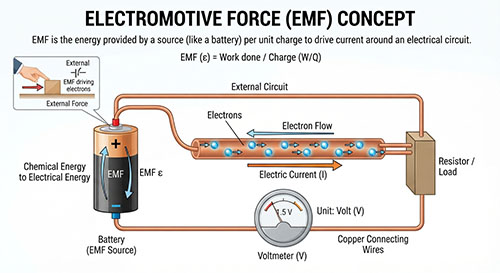
Unit and Definition of Electromotive Force: Electromotive Force referred to simply 'EMF' is the force that drives the flow of electrons (and thus electric current) through a conductor when a potential difference is established across its two ends. A potential difference can be created across the ends of a conductor using a generator, a battery or any other suitable means. The voltage generated through such a potential difference as produced by a generator or a battery is known as Electromotive Force (EMF). Just as it is impossible to move an object from one place to another without the application of an external or mechanical force, it is likewise impossible to cause electrons to flow without an electromotive force (EMF).
Therefore, we can state: "The electrical force that facilitates the flow of electrons through a conductor is called Electromotive Force or EMF."
It is measured using a voltmeter which must be connected in parallel with the circuit or conductor.
Difference between potential difference (P.D.) and electromotive force (E.M.F.):
|
Potential Difference (P.D.) |
Electromotive force (E.M.F.) |
|
This is an effect resulting from an electric current. |
This is the primary cause of the generation of electric current. |
|
The work done is the transfer of a unit charge between any two specific points in a circuit. |
The total work done in moving a unit charge around a complete circuit including the cell. |
|
Its value can be obtained only when the circuit is closed and an electric current is flowing. |
It exists in both open and closed circuit states. |
|
When an electric current is flowing, its value is less than the electromotive force (V < E). |
When an electric current is flowing, its value is always greater than the potential difference (E > V). |
|
It depends directly on the value of the resistance between two points. |
It does not depend on the external resistance of the circuit; it depends solely on the nature of the source. |
|
A potential difference is created between any two points in a circuit. |
EMF creates a potential difference across a circuit. |
A table listing several electrical quantities, their units, the instruments used to measure them and how these instruments are connected is provided below:
|
Electrical quantity |
Symbol |
Unit |
Measuring instrument |
What kind of connection? |
|
Voltage |
V | Volt |
Voltmeter |
Parallel |
| Current | I | Ampere |
Ammeter |
Series |
| Resistance | R | ohm |
Ohmmeter |
Both (parallel and series) |
| Power | P | Watt |
Wattmeter |
In the C C series, P.C in parallel |
| Energy | E | Killowatt-hour |
Energy meter |
In the C C series, P.C in parallel |
| Inductance | L | Henry |
Inductance meter |
Parallel |
| Capacitance | C | Farad |
Capacitance meter |
In the C C series, P.C in parallel |
| power factor | P.f |
Power factor meter |
Parallel | |
|
Magnetic flux |
Ø | Weber |
Fluxmeter |
Parallel |
| Charge | Q | Coulomb |
Charge Meter |
Series |
| Frequency | f | Hertz |
Frequency meter |
Parallel |
Very Short Question & Answer (VSA):
Question: 1. what is electricity or how is it defined?
Ans: Electricity is a form of invisible energy that arises from the presence of charged particles such as electrons or protons within matter, or from the flow of electrons through a conductor driven by voltage. Although it cannot be seen with the naked eye, we can perceive its effects and harness it for various purposes (such as producing light, generating heat, or operating machinery).
Question: 2. what is the meaning of potential difference?
Ans: 'Potential difference' refers to the difference in electric potential between two points in an electrical circuit. In simpler terms, the amount of work done or energy expended to move a unit positive charge from one point to another is called the potential difference between those two points. This is commonly referred to as voltage.
Question: 3. what is a molecule? What are the fundamental particles of an atom?
Ans: Molecule: The smallest particle of an element or a compound that can exist independently while retaining the chemical properties of that substance yet does not participate in chemical reactions is called a molecule. For example: water molecule (H2O), hydrogen molecule (H2), oxygen molecule (O2) etc.
The fundamental stable particles of an atom are: electrons, protons and neutrons.
The fundamental unstable particles of an atom are: neutrinos, antineutrinos, positrons, mesons etc.
Composite particles: Besides stable and unstable particles, some heavier particles are also found in an atom. For example: alpha particles, deuterons etc.
Question: 4. what is meant by an atomic shell?
Ans: An atomic shell (or orbit/energy level) refers to a specific circular path around the nucleus the center of an atom along which negatively charged electrons continuously revolve. Starting from the orbit closest to the nucleus, these are designated sequentially by the letters K, L, M, N, etc. (or identified by principal quantum numbers, such as n = 1, 2, 3, 4, etc.).
Question: 5. what does an atom's nucleus contain?
Ans: An atomic nucleus contains protons and neutrons. These two particles are collectively called nucleons.
Question: 6. what is a unit of the coulomb?
Ans: The coulomb is the SI unit of electric charge.
"The amount of charge that flows through a conductor when a current of 1 ampere passes through it in 1 second is called 1 coulomb."
Question: 7. what is meant by one coulomb?
Ans: "The amount of charge that flows through a conductor when a current of 1 ampere passes through it in 1 second is called 1 coulomb." In other words, charge (Q) = current (I) × time (t); if I = 1 and t = 1, then Q = 1.
Question: 8. Show the electron configurations of copper, aluminum, silicon and germanium.
Answer: The electron configuration of copper is Cu (29) = 1s²2s²2p⁶3s²3p⁶3d¹⁰4s¹
The electron configuration of aluminum is Al (13) = 1s²2s²2p⁶3s²3p¹
The electron configuration of silicon is Si (14) = 1s²2s²2p⁶3s²3p²
The electron configuration of germanium is Ge (32) = 1s²2s²2p⁶3s²3p⁶3d¹⁰4s²4p²
Question: 9. what is meant by voltage?
Answer: Voltage is the electrical potential difference between two points in an electrical circuit or conductor; it acts as the pressure or force that drives the flow of electrons. In other words, the force or pressure required to displace the electrons of the atoms within a conductor is called voltage.
Question: 10. What effects are observed as a result of the flow of electricity (electric current)?
Answer: The flow of electricity results in four primary effects:
-
Thermal Effect
-
Magnetic Effect
-
Chemical Effect
-
Physiological Effect
Question: 11. What do you understand by valence electrons?
Answer: The electrons present in the outermost energy level (or the outermost shell) of an atom are called valence electrons.
For example:
Copper has 1 valence electron.
Aluminum has 3 valence electrons.
Silicon has 4 valence electrons.
Germanium has 4 valence electrons.
Question: 12. What charges do the protons, electrons and neutrons of an atom carry?
Answer: The charges carried by the protons, electrons, and neutrons of an atom are as follows:
-
Proton: Carries a positive charge (+1) or (+1.602 x 10⁻¹⁹ coulombs).
-
Electron: Carries a negative charge (-1) or (-1.602 x 10⁻¹⁹ coulombs).
-
Neutron: Carries no charge; it is uncharged or neutral (charge = 0).
Question: 13. What is an electric charge?
Answer: Electric charge is a fundamental and characteristic property of matter, by virtue of which an object experiences a force or undergoes attraction or repulsion when placed within an electromagnetic field. Alternatively, electric charge can be defined as the amount of current (or the quantity of electrons) flowing through an electric circuit per unit of time. As we know, electric charge (Q) = It coulombs.
Question: 14. What is meant by the mass number of an atom?
Answer: The sum of the number of protons and the number of neutrons present in the nucleus of an atom is called the mass number of that atom. In other words, for any atom, mass number = number of protons + number of neutrons.
Question: 15. What is meant by the atomic number of an atom?
Answer: The total number of protons present in the nucleus or the total number of electrons present in the orbits of an atom of an electrically neutral element is called the atomic number of that element.
Question: 16. What does the maximum number of electrons that can revolve in an atom's orbit depend on?
Answer: The electron-holding capacity depends on the distance from the nucleus and the sequence of energy levels. The formula is: maximum number of electrons = 2n², where 'n' is the number of the orbit or energy level.
Question: 17. Write the units for electric charge, current and voltage.
Answer: The SI units for electric charge, current and voltage are given below:
-
Electric Charge: The unit is the coulomb, symbol C.
-
Electric Current: The unit is the ampere, symbol A.
-
Voltage: The unit is the volt, symbol V.
Question: 18. What is static electricity?
Answer: Electricity or charge that remains stationary or confined to the surface of an object rather than moving through a conductor is called static electricity.
Alternatively, electricity that remains restricted to its point of origin is known as static electricity.
Question: 19. Show the structure of a copper atom in a diagram.
Answer: The structure of a copper atom is shown in the diagram:
Question: 20. One coulomb = the charge of how many electrons?
Answer: One coulomb (1 C) of charge = the charge of approximately 6.25 × 10¹⁸ electrons.
Question: 21. What is current? State its unit.
Answer: Current or electric current is the rate at which electrons or electric charges flow through a conducting material (such as a wire, conductor or circuit) over a given period of time.
In other words, the flow of charge or electrons through a conductor is called current. It is represented by the symbol 'I'.
The SI unit of current is the Ampere, which is abbreviated as 'A'.
Question: 22. What are the charge and mass of an electron?
Answer: Charge of an electron:
-
SI unit: -1.602 x 10⁻¹⁹ coulombs (C)
-
Relative charge: -1 (negative)
Mass of an electron:
-
SI unit: 9.109 x 10⁻³¹ kilograms (kg)
-
CGS unit: 9.109 x 10⁻²⁸ grams (g)
-
Relative mass: Approximately 1/1836 of the mass of a proton.
Question: 23. Define E.M.F.
Answer: EMF or electromotive force is the amount of energy supplied or work done by an electrical source (such as a battery, generator or solar cell) to move a unit charge around an entire circuit.
In other words, the electrical force that causes current to flow through a conductor or a circuit is known as electromotive force.
Question: 24. Which is the lightest particle in an atom?
Answer: Electron.
Question: 25. If the number of orbits is 4, what is the number of electrons?
Answer: The number of electrons in any orbit = 2n², where n = 4 (the orbit number).
Therefore, the number of electrons = 2 × 4² = 2 × 16 = 32.
Question: 26. How many types of electricity (or current) are there and what are they?
Answer: Electricity or current is primarily of two types:
-
Static electricity and
-
Dynamic electricity (or current electricity)
Question: 27. What is current electricity?
Answer: The continuous flow of electrons or charges through a conductor, driven by voltage is called current electricity.
Current electricity is of two types:
-
AC (Alternating Current) and
-
DC (Direct Current)
28. What components make up an atom?
Answer: A nucleus and orbiting electrons.
29. What is the term for the capacity of a charged object to perform work?
Answer: Electric potential.
30. What is an atom called when it loses an electron?
Answer: A positive ion.
31. What is an atom called when it gains an electron?
Answer: A negative ion.
32. What is the number of free electrons in one cubic centimeter of copper at room temperature?
Answer: At room temperature, the number of free electrons in one cubic centimeter (cm³) of copper is approximately 8.49 × 10²² (or about 8.5 × 10²²). Since one valence electron from each copper atom becomes free and participates in electrical conduction, the total number of atoms is equal to the number of free electrons.
33. One international volt = how many volts?
Answer: 1 international volt ≈ 1.00033 volts
34. One international ohm = how many ohms?
Answer: 1 international ohm = 1.0000495 ohms (SI ohm).
35. How many calories of heat are required to perform one joule of work?
Answer: Approximately 0.239 calories or more precisely about 0.23906 calories of heat are required to perform one joule of work. 1 joule ≈ 0.24 calories.
36. How is static electricity generated?
Answer: Static electricity is primarily generated through the exchange or transfer of electrons between two different electrically conductive materials; this can occur via processes such as friction, contact or magnetic induction.
37. How does an object become charged?
Answer: An object or conductor becomes charged when electrons are either added to it or removed from it. Adding electrons results in a negative charge, while removing electrons results in a positive charge.
38. How many times heavier is a proton compared to an electron?
Answer: A proton is approximately 1,836 times (more precisely, 1,836.15 times) heavier than an electron. In many contexts, it is also referred to as being approximately 1,840 times heavier.
39. What does the atomic weight of an element depend on?
Answer: The atomic weight of an element depends on the sum of the number of protons and neutrons in its atom.
40. What does the atomic number of an element depend on?
Answer: The atomic number of an element depends on the number of protons in its atom.
41. What is the mass of an electron?
Answer: The mass of an electron is approximately 9.109 × 10⁻³¹ kg or 9.11 × 10⁻²⁸ grams.
42. What is the mass of a neutron?
Answer: The mass of a neutron is approximately 1.675 × 10⁻²⁴ grams or 1.6749 × 10⁻²⁷ kilograms.
43. Give some examples of the practical effects of thermal phenomena (heating effects).
Answer: Electric lamps, electric irons, electric heaters, electric kettles, electric ovens, etc.
Short Question & Answer (SA):
1. Show the electron configuration of a copper atom.
Answer: The electron configuration of copper is Cu(29) = 1s22s22p63s23p63d104s1
2. Draw a diagram of the atomic structure of aluminium.
Answer: The electron configuration of aluminium is Al(13) = 1s²2s²2p⁶3s²3p¹ and the diagram of its atomic structure is provided below:
3. What is meant by potential difference? Explain.
Answer: Potential difference is defined as the amount of work done in moving a unit positive charge from one point to another within an electric field.
Explanation: Relationship between work and charge: If an amount of work W is required to move a charge Q from one point to another within an electric field, then the potential difference (or voltage (V) between those two points is given by V = W/Q, where W is the work done and Q is the charge.
In other words, if 1 joule (1J) of work is required to move 1 coulomb (1C) of charge from one point to another, the potential difference between those two points is 1 volt.
In the SI system, the unit of potential difference is the volt (V).
It is measured using a voltmeter, which must be connected in parallel within the circuit.
4. What is meant by current electricity and static electricity?
Answer: Static electricity: When electric charges do not move but remain stationary or confined to a single location on the surface of an object or an insulator, it is called static electricity.
Origin: Typically, when two insulating objects are rubbed against each other, an exchange of electrons occurs. As a result, one object accumulates electrons and acquires a negative charge, while the other object develops a positive charge.
Characteristics: The electric charge does not flow; instead, it remains confined to the point of origin and dissipates (becomes inactive) within a short time.
Examples: Attracting small pieces of paper using a comb that has been rubbed against dry hair; or lightning, which is caused by friction within clouds.
Current Electricity: When electric charges or electrons flow continuously or steadily through a conductor (such as a wire) under the influence of voltage, it is called current electricity.
Origin: It is generated by applying a potential difference (voltage) from a source, such as a battery, a generator or various types of power plants.
Characteristics: The electric charge remains in motion meaning it can travel from one location to another rather than being confined to its point of origin and it remains active at all times.
Examples: Electricity used to operate appliances in our homes (such as fans, lights, refrigerators or laptops) or the current flowing from a mobile phone battery.
5. Why does an object become positively charged?
Answer: Under normal conditions, an atom contains an equal number of protons (positive charges) and electrons (negative charges), making the object electrically neutral. However, if one or more electrons move from the outermost shell of an atom to another atom, the resulting deficit of electrons causes the influence of the protons that is, the positive charge to become dominant. Consequently, the object becomes positively charged.
For example: Na - e = Na+
6. Why does an object become negatively charged?
Answer: Under normal conditions, an atom contains an equal number of protons (positively charged) and electrons (negatively charged), making the object electrically neutral. However, when one or more electrons from the outermost shell of another atom move into the outermost shell of a given atom, the number of electrons exceeds the number of protons. This increases the influence of the electrons that is, the negative charge causing the object to become negatively charged.
For example: Cl₂ + 2e⁻ = 2Cl⁻
7. Explain why "copper is an excellent conductor."
Answer: Copper is an excellent conductor of both electricity and heat. The primary reasons for this are as follows:
-
Ease of electric current flow: When a potential difference (voltage) is applied across the two ends of a copper wire, the free electrons move easily from the negative terminal toward the positive terminal, which generates an electric current.
-
Since a copper atom has a single electron in its outermost shell, it can lose this electron very easily; this is why it is an excellent conductor.
-
Low Resistance: Since copper has a very low specific resistance (resistivity), only a negligible amount of energy is lost as heat when electricity flows through it.
-
Thermal Conductivity: Due to a high number of free electrons and its specific atomic structure, copper can rapidly conduct heat from one place to another.
-
Presence of Free Electrons: Copper has an atomic number of 29, and its outermost energy level or valence band contains free electrons that can move about easily and freely within the atomic structure.
8. What is meant by the heating effect of electric current? How is it useful to us?
Answer: When an electric current flows through a conductor (such as a wire), a portion of the electrical energy is converted into heat energy due to the conductor's resistance, causing the conductor to heat up. In other words, as electrons move through the conductor, they collide with its atoms and molecules. The work done to overcome this resistance results in the generation of heat. The generation of heat resulting from the flow of electric current is known as the heating effect of electric current.
The heating effect of electric current is widely utilized in daily life and across various industrial sectors. Its primary applications are listed below:
Household appliances: Electric irons, water heaters (geysers), toasters, and electric kettles are all designed based on this thermal effect.
Light sources: In traditional incandescent light bulbs, when an electric current passes through the tungsten filament, it heats up intensely and emits light.
Safety Protection (Fuse): A fuse wire is used in electrical circuits. If an excessive amount of electric current flows through the circuit, the fuse wire melts due to the heating effect, thereby breaking the connection. This helps prevent major accidents or fires, protecting homes and buildings.
Industrial Applications and Metal Melting: In large electric furnaces, this heat is utilized to melt various metals and process them in different ways.
It generally operates according to Joule's law of heating (H = I²Rt).
9. What is meant by the chemical effect of electricity? How is it useful to us?
Answer: The chemical effect of electricity is a process in which the flow of an electric current through a liquid substance or solution causes chemical changes, resulting in the formation of new substances. This process is known as the chemical effect of electricity.
The chemical effect of electricity has numerous applications in daily life and industrial processes. Its primary uses are mentioned below:
Electroplating: This process is used to apply a coating of a valuable or corrosion-resistant metal onto a less expensive metal. Examples include coating iron with zinc or chromium to prevent rust and applying a layer of gold or silver to imitation jewelry.
Metal Extraction and Purification: This method is used to isolate and refine pure metals (such as aluminum, copper, sodium, etc.) from ores obtained through mining.
Battery operation and charging: In the rechargeable batteries used in mobile phones, cars, or IPS (Instant Power Supply) systems, chemical energy is converted into electrical energy, and during the charging process, electrical energy is converted back into chemical energy.
Production of chemical substances and gases: Hydrogen and oxygen gases are produced through the electrolysis of water. Furthermore, this process is widely used to produce chlorine gas and caustic soda from salt solutions.
Production of metal casts and blocks: Electrolysis is used in the creation of character blocks for printing, as well as in the production of various metal coins or medals.
Furthermore, the chemical effects of electricity are utilized for many other purposes.
10. What is meant by the magnetic effect of electric current? How is it useful to us?
Answer: When an electric current flows through a conducting wire, a magnetic field is created around it; this phenomenon is known as the magnetic effect of electric current.
This technology is widely used in various fields, ranging from everyday life to modern industry and medicine. For example:
Electric Motor: It is used to convert electrical energy into mechanical energy to drive components such as fans, water pumps, washing machines, and the motors in electric vehicles.
Electric Bell: Used in homes, offices, or schools, an electric bell employs an electromagnet to cause a hammer to strike the bell.
Loudspeaker and Microphone: These play an essential role in generating sound waves and converting electrical signals into sound.
Lifting heavy loads: Powerful electromagnets are used in large factories, at sites where trains have derailed, and at ports to move heavy pieces of iron or steel from one place to another.
Medical science (MRI scans): Extremely powerful electromagnets are utilized in MRI machines to capture precise images of the internal organs of the human body.
Modern transportation (Maglev trains): High-speed magnetic levitation (Maglev) trains employ electromagnetism to hover and travel above the railway tracks.
Electrical Safety and Switching: It is used to protect equipment by controlling the flow of excess electric current a function performed by circuit breakers and relay switches.
11. Why is an atom electrically neutral?
Answer: In its normal state, an atom contains an equal number of protons (positively charged) and electrons (negatively charged); consequently, it remains neutral.
12. What is the fundamental difference between static electricity and current electricity?
Answer: The key differences between static electricity and current electricity are provided below:
|
Static electricity |
current electricity |
|
1. Since the material is an insulator, the charge remains stationary or bound. |
1. Charge flows through a conductor. |
|
2. It is primarily generated through friction. For example: lightning. |
2. It is generated from a battery, solar source, dynamo or generator. |
|
3. It lasts for a short time or is discharged suddenly. in other words, it is transient. |
3. It continues to operate as long as the circuit is on; that is, it is persistent. |
|
4. Name of the instrument used to measure it: Gold leaf electroscope |
4. The names of the instruments used for its measurement are: ammeter, voltmeter, multimeter or AVO-meter. |
Mathematical Problems and Answers: Chapter 1
1. Convert 7 kΩ into ohms, milliohms, microohms, nanoohms and picoohms.
Answer: 7 kΩ = 7 x 1000 = 7000 Ω (We know, 1 kΩ = 1000 Ω)
7000 Ω = 7000 x 1000 = 7 x 10⁶ mΩ (We know, 1 Ω = 1000 mΩ)
7000 Ω = 7000 x 10⁶ = 7 x 10⁹ µΩ (We know, 1 Ω = 10⁶ µΩ)
7000 Ω = 7000 x 10⁹ = 7 x 10¹² nΩ (We know, 1 Ω = 10⁹ nΩ)
7000 Ω = 7000 x 10¹² = 7 x 10¹⁵ pΩ (We know, 1 Ω = 10¹² pΩ)
2. Convert 6 kΩ into ohms, megaohms, gigaohms and teraohms.
Answer: 6 kΩ = 6 x 1000 = 6000 Ω (We know that 1 kΩ = 1000 Ω)
6000 Ω = 6000/10⁶ = 6 x 10⁻³ MΩ (We know that 1 MΩ = 10⁶ Ω)
6000 Ω = 6000/10⁹ = 6 x 10⁻⁶ GΩ (We know that 1 GΩ = 10⁹ Ω)
6000 Ω = 6000/10¹² = 6 x 10⁻⁹ TΩ (We know that 1 TΩ = 10¹² Ω)
3. Convert 55 x 10⁷ millivolts (mV) into volts (V), kilovolts (kV), megavolts (MV) and gigavolts (GV).
Answer: 55 x 10⁷ mV = 55 x 10⁷ x 10⁻³ = 55 x 10⁴ V (We know that 1 V = 1000 mV, or 1 mV = 10⁻³ V)
55 x 10⁴ V = 55 x 10⁴ x 10⁻³ = 55 x 10¹ = 550 kV (We know that 1 kV = 1000 V, or 1 V = 10⁻³ kV)
55 x 10⁴ V = 55 x 10⁴ x 10⁻⁶ = 55 x 10⁻² = 5.5 x 10⁻³ MV (We know that 1 MV = 10⁶ V, or 1 V = 10⁻⁶ MV)
55 x 10⁴ V = 55 x 10⁴ x 10⁻⁹ = 55 x 10⁻⁵ = 5.5 x 10⁻⁶ GV (We know that 1 GV = 10⁹ V, or 1 V = 10⁻⁹ GV)
Broad/Eassy type Question:
1. Define current, voltage and resistance, including their units and explanations; also, name the instruments used to measure them.
2. What is an atom? What are its fundamental components? Explain the atomic structure and electron configuration of copper and aluminum, providing diagrams.
3. What is electricity? How many types of electricity are there and what are they? Provide a brief description of the effects (phenomena) that occur due to the flow of electricity.
4. What is meant by potential and potential difference? Provide a mathematical explanation for both accompanied by diagrams.