An easy way to interpret soil test reports.
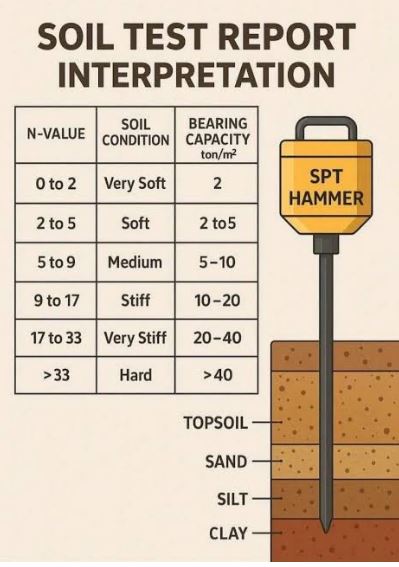
You can easily determine the condition of the soil by looking at the 'N-value' from a soil test:
1. An N-value of 2 or less indicates 'very soft' soil, with a load-bearing capacity of only 2 tons per square meter.
2. An N-value of 2–5 indicates 'soft' soil, with a load-bearing capacity of 2–5 tons per square meter.
3. An N-value of 5–9 indicates 'medium' soil, with a load-bearing capacity of 5–10 tons per square meter.
4. An N-value of 9–17 indicates 'stiff' (firm) soil, with a load-bearing capacity of 10–20 tons per square meter.
5. An N-value of 17–33 indicates 'very stiff' (very firm) soil, with a load-bearing capacity of 20–40 tons per square meter.
6. An N-value above 33 indicates 'hard' (very solid) soil, with a load-bearing capacity exceeding 40 tons per square meter.
How many boreholes are required for a given area of land?
1. For land up to 3 kathas: 3 boreholes.
2. For 3–5 kathas: 5 boreholes.
3. For 5–10 kathas: 8 boreholes.
What is a Soil Test?
In Bengali, 'soil test' literally means testing the soil. However, in engineering terminology, the process of testing the subsurface soil for a structure or building is referred to as a 'soil test' or 'sub-soil investigation.'
Why is a Soil Test conducted?
A soil test is performed to determine the safe load-bearing capacity of the subsurface soil. It is important to note that a soil test is essential for the design of any type of structure such as residential or commercial buildings, educational institutions (schools/colleges), religious structures (mosques/temples), hospitals, shopping complexes, bridges, culverts, roads, highways, railway lines, airports, power plants, and more.
However, since the safe bearing capacity of the soil in our country is typically 9–10 tonnes per square metre, engineers generally do not recommend soil testing for light structures (such as one- or two-storey buildings), as the foundations of these structures do not encounter loads exceeding this capacity. That said, soil testing is absolutely essential for buildings with more than two storeys.
Remember, designing a structure without a soil test is like taking medication without a doctor’s prescription. It is impossible to determine the characteristics of the subsurface soil otherwise; only by examining a soil test report can an engineer specify the type of foundation required to ensure the safety of a structure.
How is a soil test conducted?
In our country, soil investigation is typically carried out using the 'wash boring' method. In this process, a 2-inch diameter pipe is driven into the ground by hammering, with the aid of water. Soil samples are collected, and the number of hammer blows (blow count) is recorded at intervals of every 5 feet (1.5 meters).
At each 5-foot interval, the 'N-value' is recorded as the pipe is driven an additional 1.5 feet (18 inches) into the ground; however, the number of blows required for the first 6 inches of this 18-inch segment is not taken into account.
In other words, the number of blows required to achieve a penetration of 12 inches is defined as the N-value. For instance, if 15 blows are needed to drive the sampler 12 inches, the N-value is 15. This N-value varies depending on the soil layer; for example, within the first 10–15 feet, the N-value is typically very low.
*An N-value greater than 15 indicates a layer of firm or hard soil.*
What precautions should be taken during a soil test?
1. Ensure that the hammer weighs 63.5 kg and that it is being dropped from a height of 30 inches.
2. Verify that soil samples are collected and stored in separate, labeled packages at 5-foot intervals.
3. Ensure that the 'N-value' is accurately counted and recorded.
**Even if the soil appears to be of good quality, it is advisable to collect samples down to a depth of at least 60 feet.**
Who should you hire to conduct a soil test?
1. Those who possess their own laboratory, and
2. Those who have experienced geotechnical (soil) engineers on their team.
Depending on the company, the cost for each borehole ranges from 6,000 to 20,000 taka; however, if someone offers to do it for only 6,000 taka, you should realize that you will never receive an accurate report from them.
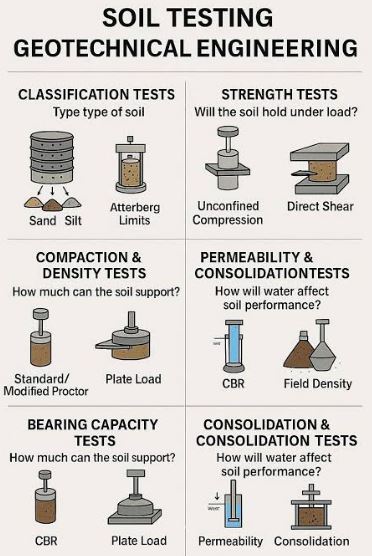
Please be aware that testing through BUET for a single borehole will cost between 70,000 and 80,000 BDT; this includes tests such as Physical & Index Properties, Compaction and Density Tests, Direct Shear Tests, Triaxial Shear Tests, Strength and Deformation Characteristics, and Permeability and Seepage Characteristics, among others.